


We recently spoke with Gary Menin Sr., the head of the Massachusetts chapter of Raptors Are The Solution (R.A.T.S.). Gary discusses his fascination with birds of prey, why they’re so vital to our ecosystem, and how rodenticides have impacted their populations. He also shares key initiatives and how people can get involved.
AT:
Why don't you start off by telling us a bit about yourself, Raptors Are The Solution and your current role there?
GM:
I'm a retired environmental compliance manager for General Electric, and when I retired I also taught physics for a couple of years. I've always had an interest in nature, ecology, bird watching, and birds of prey specifically, because I found them so inspiring — dramatic, powerful, elegant, intense.
But it wasn’t until I was over at my daughter’s house babysitting my grandchildren and found some rat poison in their entryway. I knew it wasn’t good — especially because both my daughter and son-in-law are very into organic things. I said, “This is a dichotomy… you shouldn’t be using this.” At first I was concerned about their dog and my grandchildren getting into it.
Then I started doing some research and came across an article by Ted Williams (the environmental writer, not the baseball player) who was working with Dr. Maureen Murray of Tufts Wildlife Clinic in Grafton, MA. She was reviewing autopsy photos of raptors that had succumbed to anticoagulant rodenticide poisoning. It was heart-wrenching — and it really bothered me.
So I started writing editorials and letters to the editor. Local papers ran them, people read them, and I started getting calls from folks saying, “I had no idea — I’m going to stop using these poisons.” That made me feel like I was making a difference right away: every family that stops using rat poison probably saves a raptor family somewhere in New England.
As I kept writing, I got an email from the Raptors Are The Solution people in California, and was connected to their founder, Lisa Owens Viani, who’s been working on this problem for years. She asked if I’d form a Massachusetts chapter. So right now I’m kind of an army of one — the Massachusetts representative — and that’s how I got involved.
AT:
Can you explain some of the roles birds of prey play in our ecosystem that people might not be aware of?
GM:
Sure. First, these birds of prey are apex predators. They’re at the top of the food chain. Aside from other large predators, other raptors, and humans, they don’t really have enemies. But they do have a lot of life risks — for example, any given Great Horned Owl that has two owlets has only about a 50% chance of each surviving the year.
What people often don’t realize is that if you remove these apex predators — especially here in Massachusetts and the Northeast — you worsen other problems. We have a serious Lyme disease problem. The main carrier of ticks isn’t the deer, it’s mice. Our owls and hawks eat a diet of mice almost every day, so they help us control the Lyme vector. If you poison raptors, mouse populations grow, and Lyme risk increases. That’s a direct, practical benefit of keeping these birds healthy.
As the name says, “Raptors Are The Solution” — in an ideal world we’d live in harmony with them and they’d take care of most of our rodent problems. But people want fast fixes and too often turn to poisons, which is ultimately counterproductive.
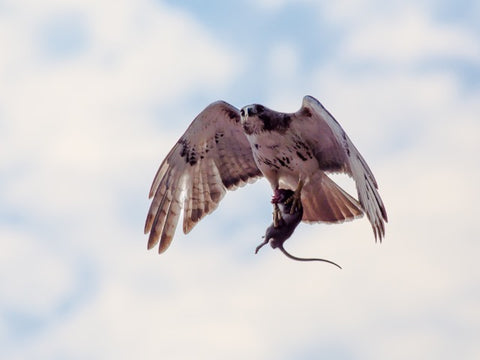
Photo courtesy of Pamela Dimeler & Raptors Are The Solution
AT:
Which birds of prey have you seen most impacted by rodenticides?
GM:
The Barred Owl has been heavily impacted. Also the Snowy Owl. In one winter around Boston they recovered 12 owls that had been poisoned — 9 died. The others were saved with vitamin therapy. These are rare visitors, and to lose that many in one season is horrific. Great Horned Owls and Red-tailed Hawks are also commonly affected.
Dr. Maureen Murray has found that every Great Horned Owl she’s tested has some level of rodenticide in its tissue — even if it wasn’t the cause of death. So the exposure is widespread.
AT:
What is the Massachusetts chapter of RATS doing to spread awareness?
GM:
I initially tried to get a 2020 ballot petition going, but it requires more than 60,000 signatures, which is a heavy lift for one person. So I pivoted to awareness work — giving talks to local groups, Audubon, animal control, town officials — basically anyone who will have me. I also drafted a local non-binding resolution in Sterling, MA, urging people not to use systemic pesticides (including rodenticides). It’s about keeping the issue in front of people and changing behavior.
AT:
What can people do at the local level — and how can they help?
GM:
First, stop using poison. Choose alternatives. Second, write to local papers and legislators to raise awareness. The more people know, the less likely they are to casually put out rodenticide. And if you’re in Massachusetts, help spread the word about local resolutions so they pass at town meetings.
AT:
We wanted to get your insight on the A24 Rat & Mouse Trap — how does it help with the rodenticide challenge?
GM:
I like just about everything about it. It’s self-baiting, self-clearing, poison-free, and pretty species-specific. It’s instantaneous — even the rats don’t suffer. And it’s “set it and forget it,” which people love. That makes it a very real alternative to poison.
Rats are smart — they aren’t always easy to convince to go where you want them — but having a toxin-free tool that can sit there and work without creating secondary poisoning for raptors is a big step in the right direction.
AT:
Lastly, where can people find you online and support what you’re doing?
GM:
Go to raptorsarethesolution.org and look for the Massachusetts chapter — you can get to me from there. Right now I’m focused on getting our local petition passed and on raising enough money for billboards across the state — something as simple as “Rat poison is killing more than rats.” Awareness is key.