


How to Identify What Type of Rat You Have

If you’re experiencing a rat problem, it’s understandable to want them out of your home quickly. If you’re like many homeowners, you may assume all rat traps are basically the same—right?
You might be surprised to learn there are more than 50 subspecies of rats, each with distinct physical traits, behaviors, and often specific diets. Understanding the common types can help you identify what you’re dealing with—and choose the right solution.
The 4 Most Common Types of Rats
If you live in North America, you’re likely encountering one of these:
- Ship rats
- Norway rats
- Marsh rice rats
- Woodrats
Let’s take a closer look at each type—their appearance, range, diet, and common diseases.
Click to view full image:
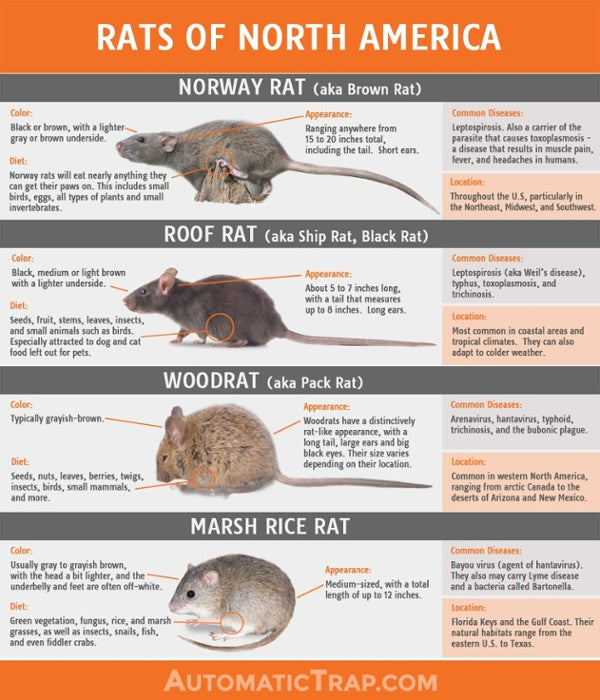
Roof Rats
Also known as black rats or roof rats, these rodents often invade homes. Bodies are ~5–7 inches (tails up to ~8 inches), up to ~0.5 lb. Fur is scraggly, black to medium/light brown with a lighter underside.
Ship rats are found on every continent, common in coastal/tropical climates but adaptable to northern U.S. diets. As omnivores, they’ll eat seeds, fruit, small animals, pet food, and more—key when considering attractants.
Known diseases include:
- Bubonic plague
- Typhus
- Weil’s disease
- Toxoplasmosis
- Trichinosis
Norway Rats
Also called brown rats, they’re among the largest—often totaling up to 20 inches including tail, and can weigh twice a black rat. Coarse fur (brown/dark gray) with lighter undersides.
Highly adaptable to climates; nest in burrows or at ground level and are strong swimmers (near lakes/rivers/pools). Found throughout U.S., especially cities with ample food. Omnivores: small birds/eggs, plants, invertebrates, scraps.
Primary disease concern includes toxoplasmosis (via parasite), which can cause muscle pain, fever, and headaches in humans.
Marsh Rice Rats
Smaller than many subspecies (often ≤12 inches total). Distinct contrast between upper body (gray/gray-brown), lighter head, and off-white underbelly/feet. Hallmarks: small cheek pouches; ears with a light hair patch in front.
Range from the East Coast to Texas and into South America; prefer wetlands and coastal marshes. Omnivores: green vegetation, marsh grasses, fungi, rice, insects, snails, small fish, occasional fiddler crabs.
Common host of Bayou virus (hantavirus); can also carry Lyme disease and Bartonella.
Woodrats
Also known as packrats: large ears, big black eyes, long tails. Found across North America—from arctic Canada to desert Southwest. Size varies by location (e.g., larger desert woodrats vs. mountain woodrats).
Omnivorous and adaptable: seeds, nuts, leaves, insects, small mammals, etc.
Associated diseases include:
- Arenavirus
- Hantavirus
- Typhoid
- Trichinosis
- Bubonic plague
- Salmonella
- Other parasite-borne illnesses
Eradicating the Problem
With the type identified, it’s time to remove them—for good. Traditional snap/glue traps demand constant setting, baiting, and checking, and can be inhumane. The Goodnature™ A24 Rat and Mouse Trap avoids those issues while quickly killing to minimize suffering. It automatically resets after each strike and uses long-life lures that attract omnivorous or vegetarian subspecies alike—so your traps work as intended no matter the rat type.
To learn more, visit our Rats of North America page.